USMCA Qualification Tool

USMCA qualification that holds up
when Customs comes asking.

Stop building RVC formulas from scratch and second-guessing product-specific rules of origin. Kendrick Trade USMCA walks you through a structured, component-level breakdown of your product, checks every part against a maintained rules database, and delivers a clear answer: qualifies or doesn't qualify.

The output includes the specific rule applied and a plain-English rationale you can hand directly to a broker, a compliance officer, or a customs auditor. No spreadsheet. No guesswork. No "trust me" in an email.

A complete qualification run in under two minutes

How It Works

Qualify a product in six clear steps

0

Getting Started

Upload your bill of materials or enter it manually. Our structured form catches missing HS codes, incomplete origin data, and blank cost fields before they become problems downstream. If you've got a BOM in a spreadsheet, you're 30 seconds from a qualification run.

1

Enter or Upload Your Bill of Materials

Paste a spreadsheet, upload a CSV, or enter components one at a time. Each input line captures the HS code, country of origin, cost, and weight for every component in your finished good. The form flags inconsistencies as you go — missing codes, ambiguous origins, values that don't add up — so the data is clean before the engine runs.

No special formatting required. If your BOM exists in any structured form, the tool accepts it.
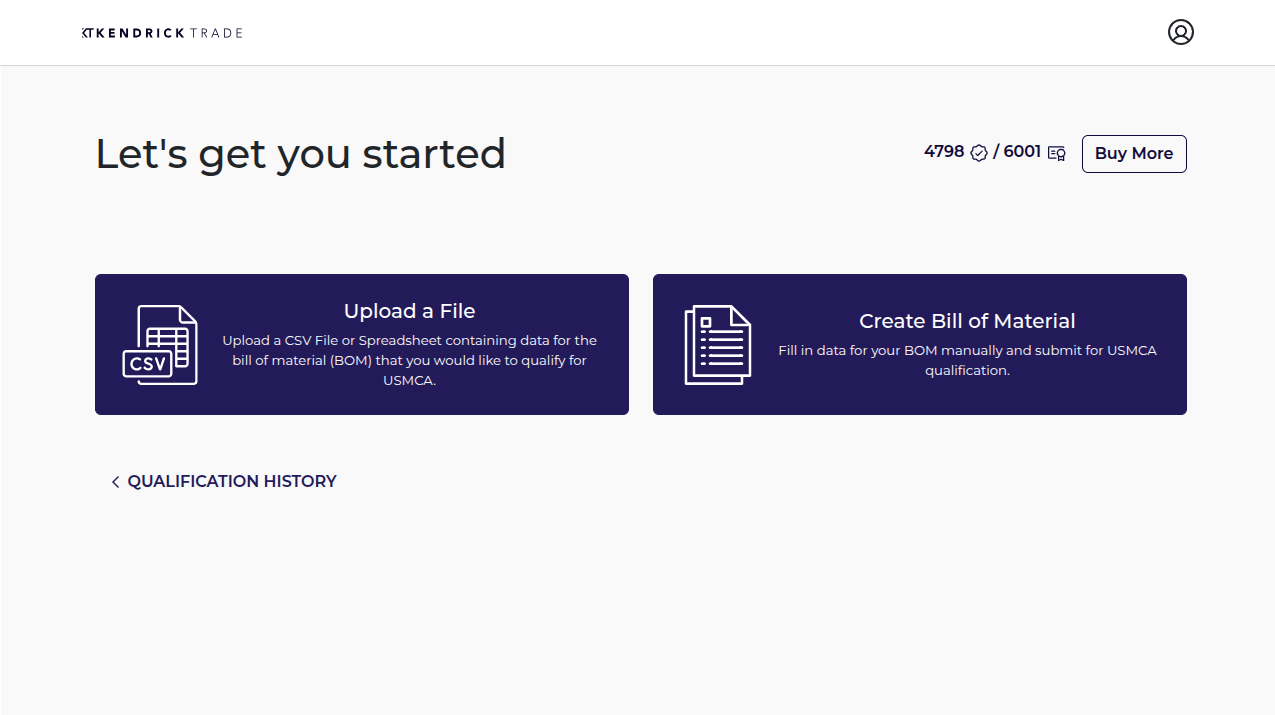
Bill of materials entry screen
2

Classify Each Component

Every component is checked against the product-specific rules tied to your finished good's HS classification. The tool identifies which components are originating, which are non-originating, and flags any that require a deeper look.

This is the step where most spreadsheet-based approaches break down. Component-level origin determinations require checking multiple rule sets simultaneously — the engine handles that automatically.
Component classification screen
3

Product-Specific Rules Are Applied Automatically

The engine checks your finished good against the maintained USMCA rules database — tariff shift requirements, regional value content thresholds, and product-specific rules of origin for your specific HS code. You don't need to open Annex 4-B or the General Notes. The engine knows which rule applies and applies it.

If the rules change, the engine updates. Your next qualification run reflects current requirements, not last year's appendix.

4

RVC Is Calculated Under Both Methods

The tool computes regional value content under both the transaction value method and the net cost method simultaneously. You don't pick one and hope — you see both results side by side with the specific components that drove each number.

Every calculation is traceable. Click any percentage and see exactly which components contributed and how. When an auditor asks how you arrived at 62% RVC, the answer is in the tool, not in your memory.

5

Get a Clear, Defensible Answer

The engine returns a binary answer — qualifies or doesn't qualify — backed by the specific rule that decided the outcome and a plain-English rationale you can hand directly to a broker, compliance officer, or customs auditor.
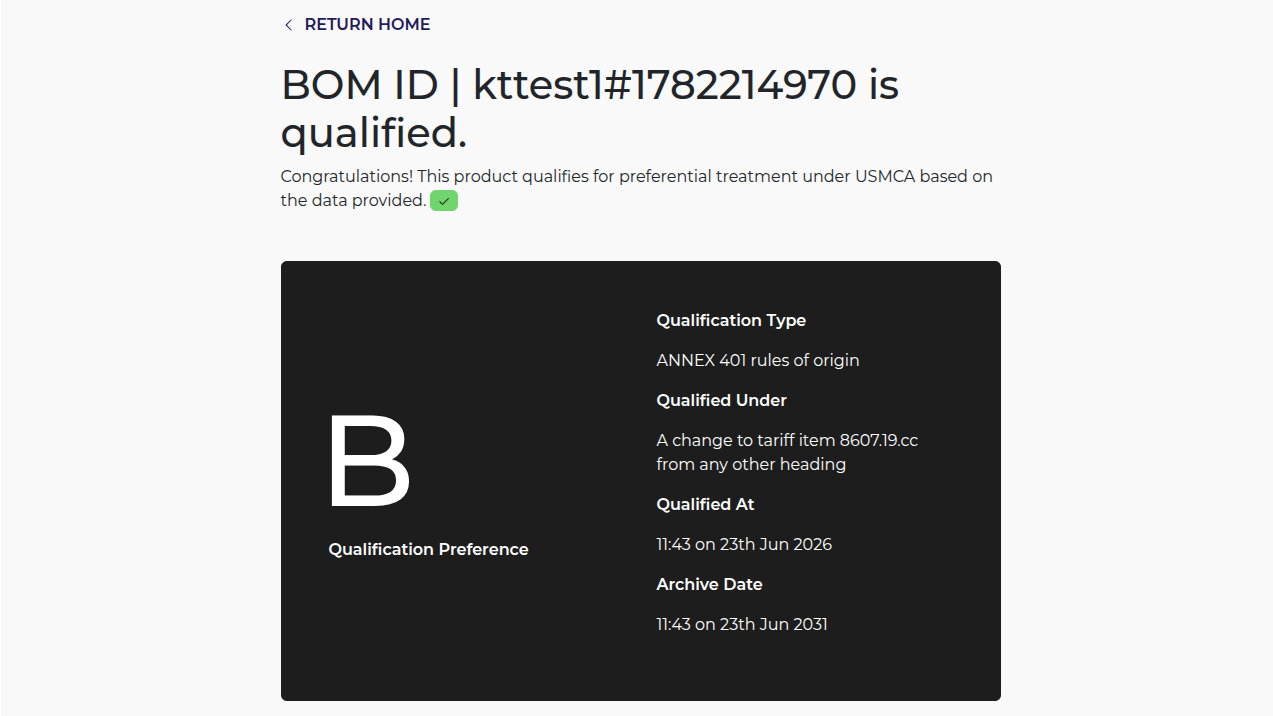
Qualifies
A change to tariff item 8607.19.cc from any other heading
Qualification result screen
6

Export Your Certificate and Rationale

Download a formatted certificate of origin with the qualification result, the applied rule, and the full component-by-component rationale. The PDF is ready to submit to customs authorities or attach to a shipment. Every number, every rule citation, every component determination — exportable, searchable, and audit-ready from the first click.
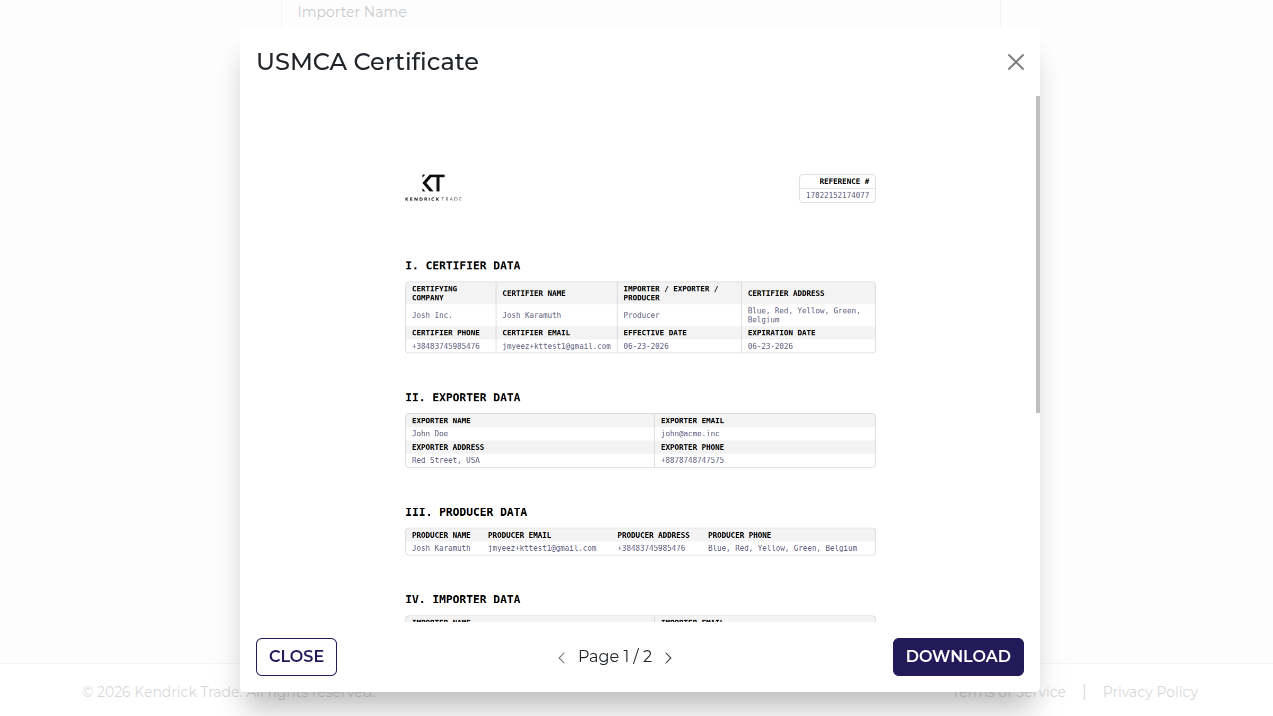
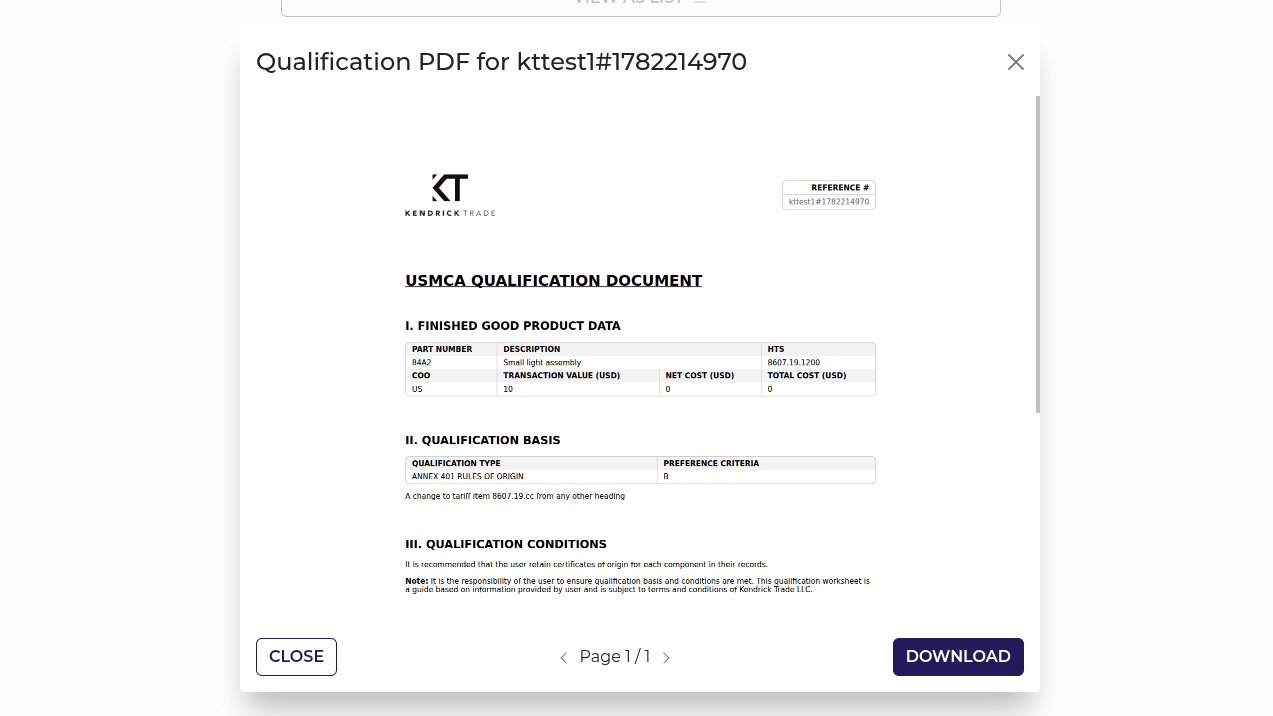
USMCA certificate of origin
Qualification PDF export
Upload a BOM and Test It

Qualification answers in minutes, not hours.

Frequently Asked Questions

Straight answers to the questions we hear most from brokers, forwarders, and compliance teams.

USMCA, or the US - Mexico - Canada Agreement, is a trade agreement between the three named countries that replaced the North American Free Trade Agreement (NAFTA). Please note that in Mexico, the agreement is referred to as Tratado entre Mexico, Estados Unidos y Canada (T-MEC)and in Canada, this agreement is referred to as the Canada - United States - Mexico Agreement(CUSMA).
No. An item coming from one of these countries isn't the same as an item originating in one of these countries. Kendrick Trade's USMCA tool analyzes Bills of Material (BOMs) to assess if the finished good meets requirements for preferential treatment as outlined in USMCA's Annex 4-B Product Specific Rules of Origin.
To qualify a good for USMCA using Kendrick's USMCA tool, you will need a costed bill of materials (BOM), origin data and HTS codes for both the finished good and its components.
The Harmonized Tariff Schedule of the United States can be found at this link. Assigning the appropriate code can be a complex process. We recommend working with a customs expert. Need help? Inquire about a Kendrick consultant.
Reach out to your supplier and ask them to provide you with a certificate of origin. If you purchase the same component on a regular basis, you can request a blanket certificate covering an extended period. It is recommended you keep certificates of origin on file in accordance with recordkeeping requirements, for no less than five years.
The importer claiming preferential tariff treatment and the exporter / producer in its territory must maintain records. The effective period is five years from date of importation for importer and five years after date on which certification of origin was completed, or longer as Party may specify. Records may be any medium, including electronic. Additional information can be found on the CBP website.
Share a certificate of origin document with your broker that contains the minimum data elements required under Annex 5-A and request that they make claim with entry. If you'd like to use our tool to create a certificate, you may do so from the history tab “BOMs Previously Submitted".
The nine requirements for a certificate of origin can be found inAnnex5-Aof the agreement. This information may be provided on an invoice or any other document. If you'd like to use our tool to create a certificate, you may do so from the history tab “BOMs Previously Submitted".
USMCA entered into force on July 1, 2020. A joint review of the agreement is set to take place six years after entry into force.

Stop defending spreadsheets and inboxes.

You've seen what manual looks like. Hours lost to RVC formulas that make you second-guess yourself. Audit trails reconstructed from memory and luck. The alternative is a USMCA qualification engine built specifically for this problem — structured component entry, automated rules application, and a defensible rationale you can hand directly to Customs.

No platform bloat. No digital transformation pitch. Just a focused walkthrough of the tool that fits your problem.